
Tiny House Windows
Windows do more in a tiny home than anywhere else: they bring in light, move air, frame views, and make a small space feel far larger. They also have to survive being towed down the highway. Here are the types, the glazing and safety that matter, and how to use windows to make the home feel bigger.
The current trend
The move is toward thermally efficient, transit-tough glazing. uPVC frames are increasingly popular because they act as a thermal break, cutting heat transfer and condensation, and double glazing with a Low-E coating and argon gas is becoming standard rather than a luxury, even in the Australian climate, keeping homes warm in winter and deflecting summer heat. Alongside that, builders are leaning into big gas-strut serveries and large picture windows for that light-filled, indoor-outdoor feel, paired with smart contact sensors that tell you if a window was left open while you are away.
Window types
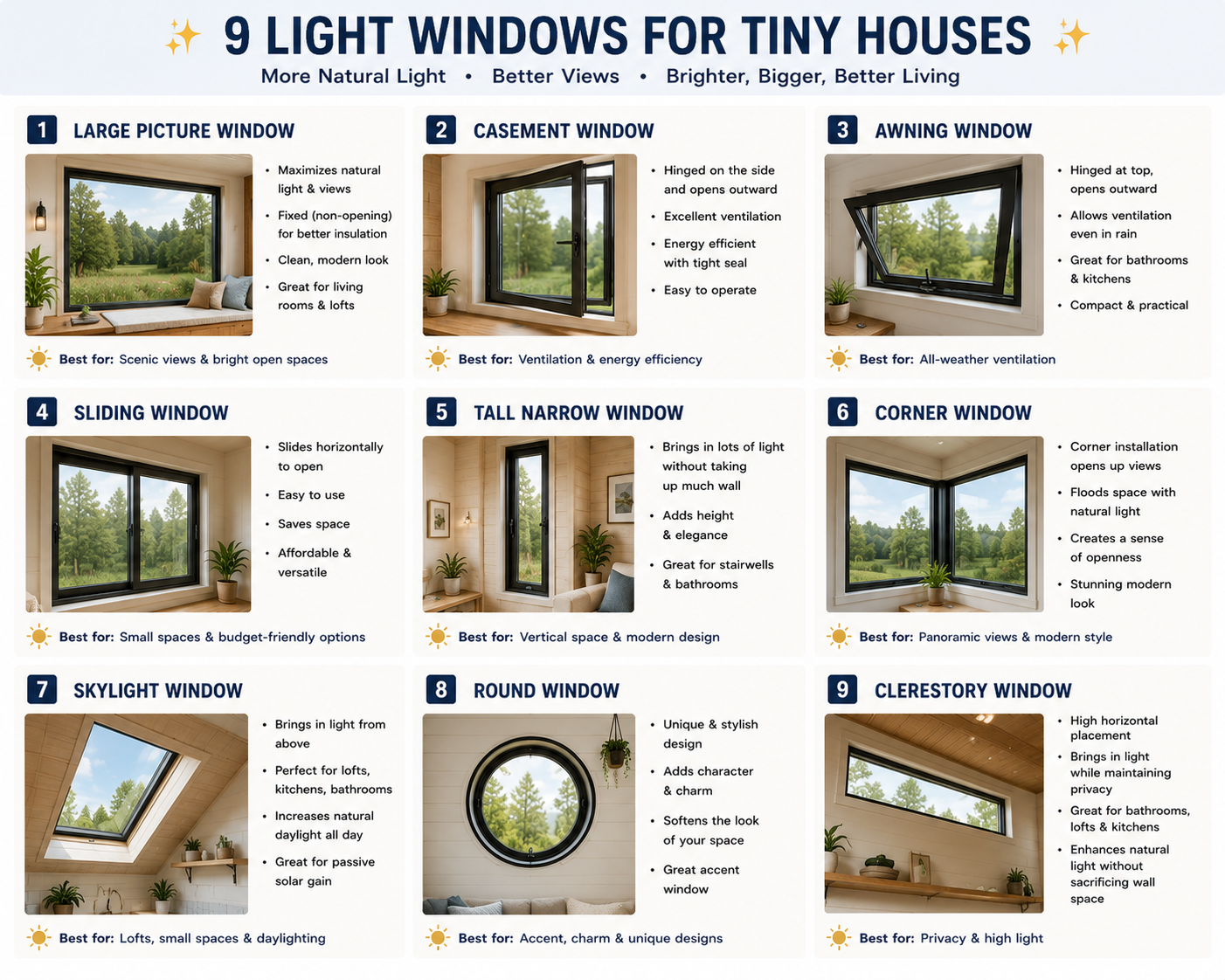
Awning windows
Hinged at the top and pushing outward, these let you keep windows open for airflow even in light rain without letting water in. A tiny-home favourite for exactly that reason.
Best for: Ventilation in any weather.
Hopper windows
Hinged at the bottom and opening inward or outward, good for high or small openings like above a kitchen bench or in a bathroom where you want air and light without a big opening.
Best for: High or compact ventilation spots.
Gas-strut / servery windows
A large window on gas struts swings fully up and out, turning a kitchen wall into an indoor-outdoor servery and creating a little awning of shade below. Brilliant for connecting the kitchen to a deck.
Best for: Indoor-outdoor flow and a deck servery.
Sliding & fixed picture windows
Sliders give easy ventilation in a flat profile; large fixed panes flood the home with light and frame a view without any opening mechanism. Used together they balance light, air and cost.
Best for: Maximising light and framing views.
Skylights & highlight windows
Roof skylights and high strip windows bring light deep into the home and into lofts, and help hot air vent upward. Great where wall space is tight or privacy matters.
Best for: Loft light and privacy with brightness.
Glazing & frames
Double (or triple) glazing. Two panes with a gas gap and a Low-E coating dramatically cut heat flow, keeping the home comfortable and reducing the energy needed to heat or cool it. Well worth it in a small space that gains and loses heat quickly.
uPVC frames. These resist heat transfer and condensation better than bare aluminium, which can sweat and form cold spots. Thermally broken aluminium and timber are other options, each with its own look and weight.
Fly screens. Australia means insects, so screens on opening windows and doors are close to essential for keeping windows open on warm nights.
Safety glass for the road
A tiny house on wheels is shaken, flexed and pelted with road debris every time it moves, so ordinary annealed glass is a real hazard. Use tempered glass (which breaks into small, blunt pieces) or laminated glass (which holds together on a plastic interlayer) in windows and glass doors.
Heavy-duty multi-point locks also help keep windows and doors from rattling or popping open in transit.
Use windows to feel bigger
Windows are one of the best tools for beating the long, narrow corridor feeling of a tiny home. A few design tricks:
Long lines of sight. Place windows so your eye always travels beyond the walls, ideally a window on the opposite wall as you step in. Windows facing each other across the home make it feel wider.
High and low for privacy. You can keep long sightlines while staying private by setting windows high or low rather than at eye level.
Borrowed outside. An open gas-strut window or an awning creates a little roof outside that, oddly, makes the inside feel larger, as does a big window framing a garden or view.