
Trailer & Foundation
The trailer is the foundation of a tiny house on wheels - everything is built on it, so it must be rated for the full weight of the finished home. Choosing the right type sets your floor height, towing stability and usable space.
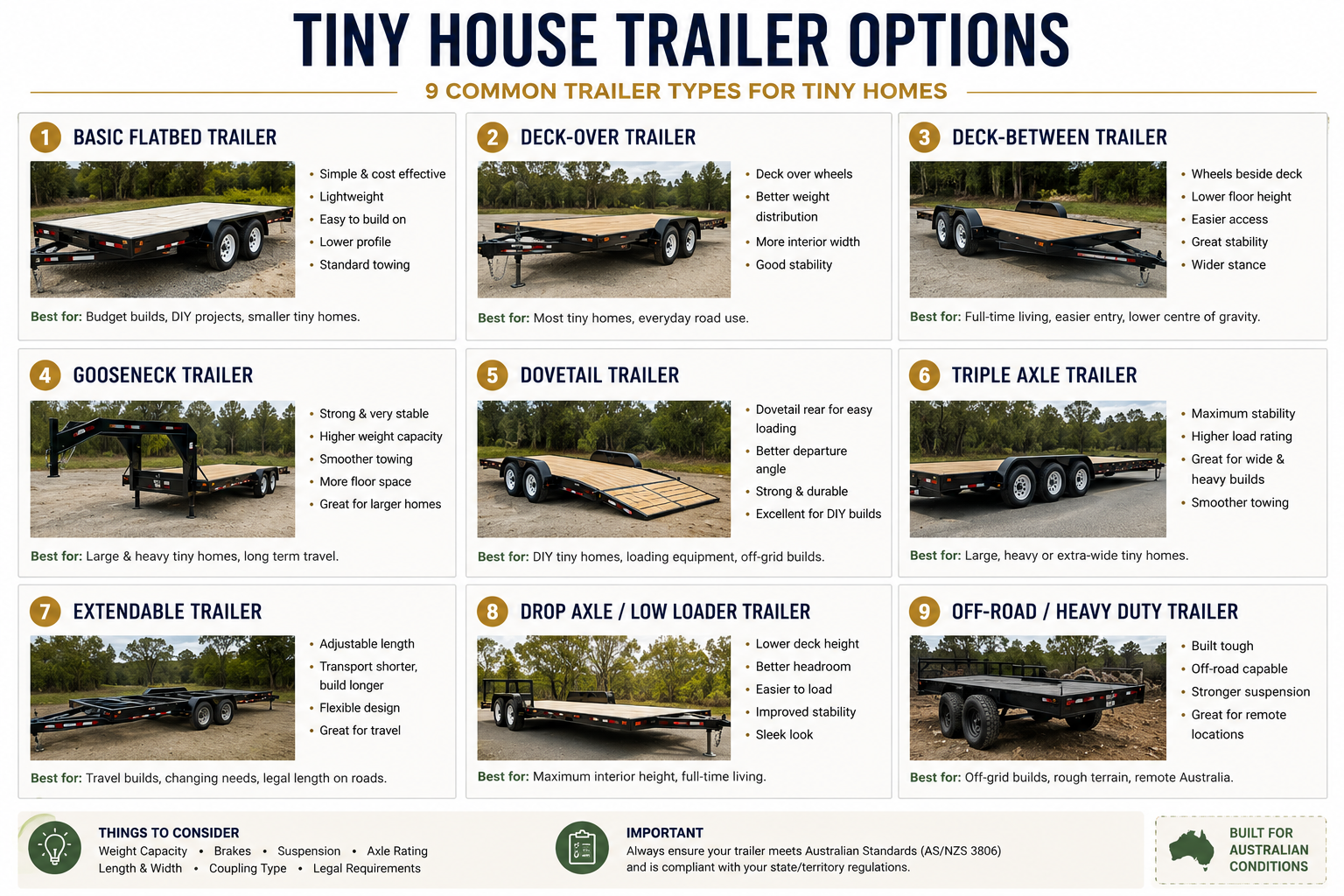
Trailer types
Deck-between (deck-low)
The floor sits between the wheel arches, low to the ground. Maximises ceiling height, which is why it is the most popular choice for tiny houses on wheels.
Best for: Most THOWs - best headroom within the 4.3 m height limit
Deck-over
The floor sits above the wheels, giving a flat, full-width floor with no wheel-arch intrusion. But it raises the floor, reducing interior height.
Best for: Wider builds where a flat floor matters more than height
Dovetail
The rear of the trailer angles down toward the road. More common on utility trailers than tiny homes, but occasionally used.
Best for: Rarely used for tiny homes
Gooseneck
Extends over the tow vehicle tray with a raised front section, adding a separate raised area - often used as a bedroom. Tows very stably.
Best for: Longer builds wanting a separate raised sleeping zone
Australian compliance
A tiny-house trailer must be built to Australian Standards and road-registrable. Key requirements include a compliance plate, LED road lighting, rust protection (hot-dip galvanising is common), and a break-away braking system on heavier trailers. Always buy from a builder who supplies the compliance plate and engineering for the rated load.
Road limits (Australia): width 2.5 m - height 4.3 m - length under 12.5 m. Within these size and weight limits, a tiny house on wheels is generally treated as a caravan: it gets a VIN and is registrable.