
Tiny House Hot Water & Solar Heating
Hot water is one of those things you only notice when it runs out. In a tiny home the trick is getting it reliably without a bulky tank or a power-hungry system, especially off-grid. Here are the main options, where each shines, and where the technology is heading right now.
The current trend
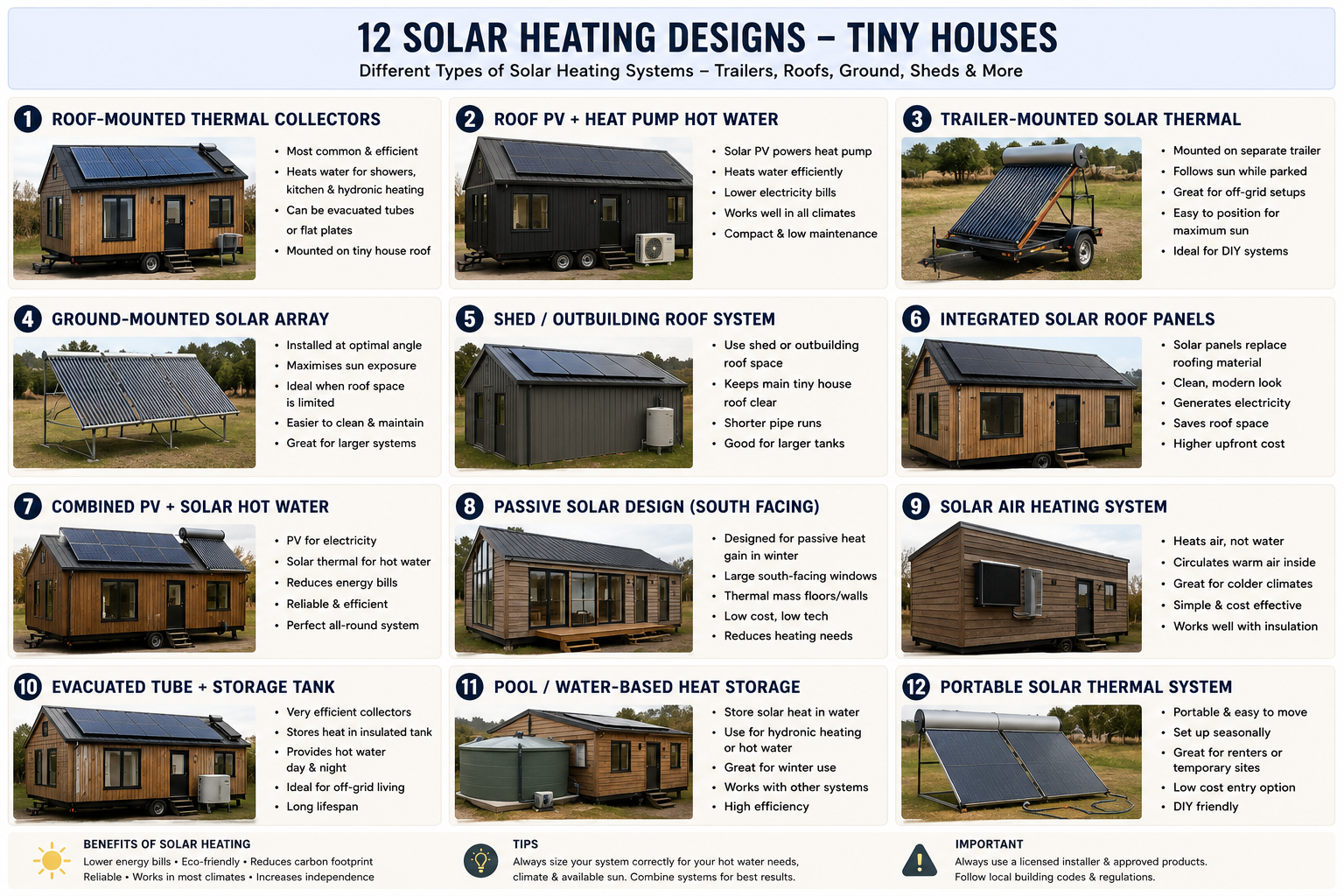
Two directions dominate right now. First, heat pumps paired with daytime solar are surging in popularity: they sip power, run on roughly a quarter of the energy of a standard element, and use solar while the sun is up so the batteries are left alone overnight. Second, low-power and no-power tankless gas keeps winning for fully off-grid homes, with 12V ignition or battery-operated units that need no mains connection at all. Across the board the move is away from bulky stored-water cylinders toward compact, on-demand, solar-smart systems, often with a timer or diverter that dumps excess midday solar into hot water.
Hot water options
Instant gas (continuous flow LPG)
The most common choice in off-grid tiny homes. A compact gas unit heats water on demand as it flows, so you never run out and there is no tank to keep hot. Modern RV and tiny-home units offer digital temperature control, run their ignition off 12V, and use far less gas than older tank systems. Some run entirely on gas with battery-operated ignition, needing no mains power at all.
Best for: Endless hot water with no tank and minimal power draw.
Heat pump
A standout for efficiency: it draws warmth from the surrounding air to heat a small tank, using only a fraction of the power of a standard electric element. Many units run on around 10 amps and pair beautifully with daytime solar, heating water while the sun is up and sparing your batteries overnight.
Best for: The most solar-friendly efficient electric option.
Point-of-use electric instant
Small under-sink or in-line electric heaters warm water instantly as it passes, with no stored cylinder to house or carry. Modern inverter models modulate power smoothly to avoid cold spikes and current surges. Simple and compact, but heating water electrically draws heavily, so they suit grid-connected homes or generous solar systems.
Best for: Saving the space and weight of a cylinder on mains power.
Solar hot water
Roof collectors heat water directly from the sun, slashing running costs in the Australian climate. Very cheap to run once installed, though it adds roof weight and usually needs an electric or gas booster for cloudy stretches.
Best for: Sunny sites chasing the lowest running cost.
12V / 240V hybrid (mobile)
For homes that move often, dual-voltage heaters can warm water on 12V while travelling and switch to 240V when parked and plugged in. A small-capacity, RV-style approach for genuinely mobile setups.
Best for: Frequently relocated, caravan-style tiny homes.
Diesel / wet-system heaters
Some cold-climate homes use diesel or hydronic systems that deliver hot water and space heating together. Capable in the cold, but more complex and a bigger investment.
Best for: Cold climates wanting heat and hot water combined.
What to consider
Power vs gas. Heating water with electricity is one of the heaviest loads in a home. Off-grid, instant gas, solar hot water or a heat pump usually beats a plain electric element, unless your solar and battery system is large.
Space and weight. Tankless and point-of-use units save the space and weight of a stored cylinder, which matters in a tiny home. Solar collectors and heat-pump tanks add weight, so factor them in.
Use your solar. A timer or diverter that sends surplus midday solar to your hot water is a cheap way to get near-free hot water and protect your batteries.
Climate. Solar hot water excels in sunny regions; in cold or cloudy areas plan a booster or a heat pump so you are never caught short. In frosty areas, insulate and protect pipes.
Safety and certification. Gas and electrical hot-water work must be installed and certified by licensed trades, with correct ventilation for any gas appliance in a small space.