
Tiny House Doors
In a tiny home, a door is not just a door, it is floor space. A standard hinged door can swallow close to a square metre just to swing, so how you handle doors has an outsized effect on how usable the home feels. Here are the options, the security that matters on the road, and where the technology is heading.
The current trend
Two clear directions. First, space-saving door mechanics: because a swinging door wastes precious floor area, builders increasingly reach for pocket doors, barn doors, and exterior sliding-glass or bifold doors to keep the interior open and usable. Second, keyless and smart entry: electronic deadbolts and fingerprint or phone-controlled locks are becoming common, giving solid security without carrying keys, and pairing with compact wireless door sensors that alert you if a door is left open while travelling or away.
Door types
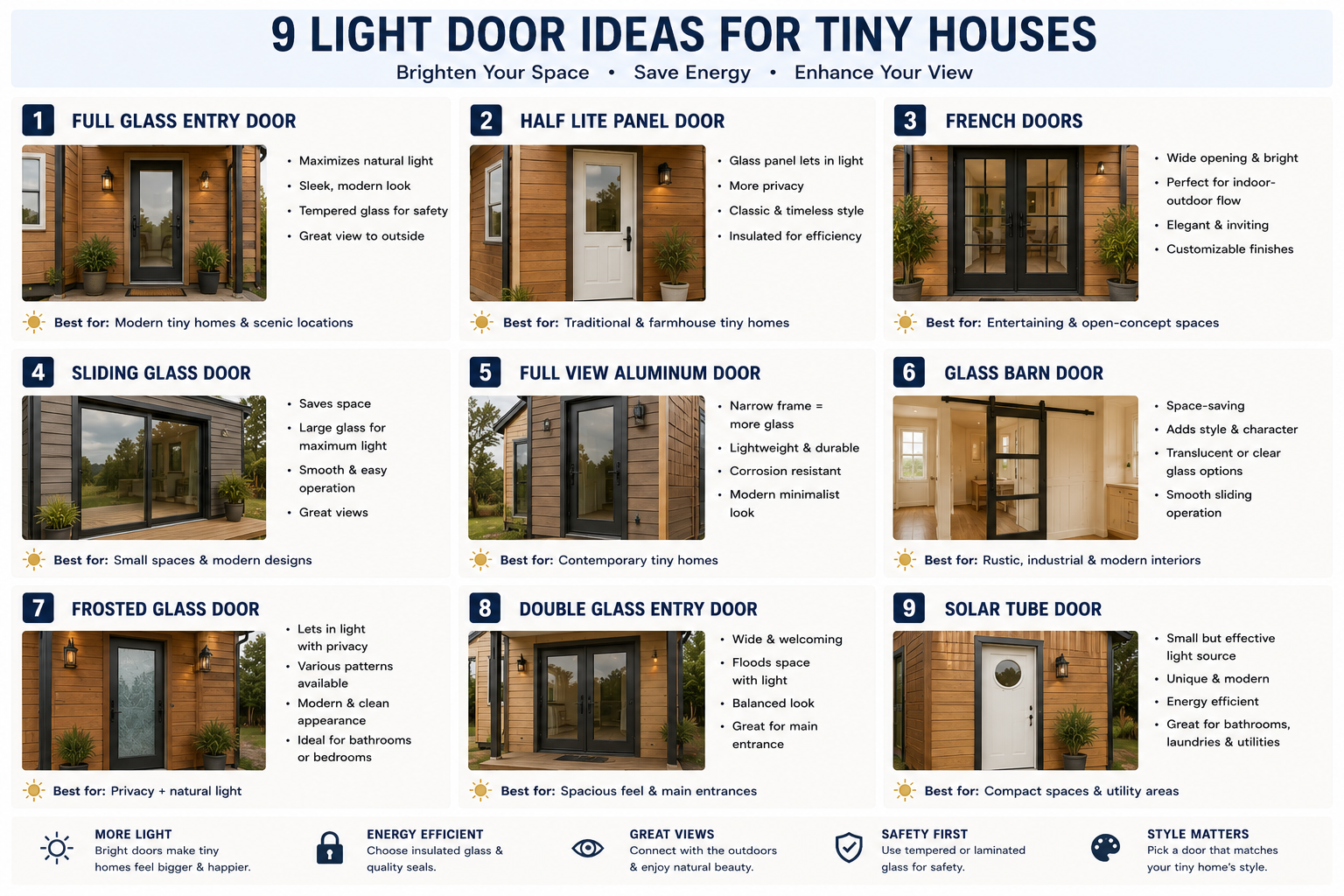
Sliding glass / stacker doors
Large glass sliders open the home to a deck and flood it with light, without a swinging panel eating floor space. The single best move for an indoor-outdoor feel, though they need safety glass and good seals for the road.
Best for: Light, views and connecting to a deck.
Bifold doors
Panels that concertina back to open a whole wall to the outside. Dramatic and space-efficient when open, folding neatly to the side rather than swinging into the room.
Best for: Opening up a full wall to outdoors.
Pocket doors
Slide into a cavity inside the wall and vanish completely, using zero floor space. Ideal for bathrooms and bedrooms where a swinging door would block the tight circulation.
Best for: Internal doors where every inch counts.
Barn / sliding doors
Slide along a track on the wall surface, so no wall cavity is needed. They add character and save the swing space of a hinged door, though they need clear wall to slide across.
Best for: A feature internal door that saves swing space.
Hinged entry door (with glass)
A solid, secure, well-sealed and insulated front door is still the most weatherproof entry. A half-glass or French style brings in light while keeping security. The main cost is the floor space it swings through.
Best for: A secure, weatherproof main entrance.
Security & the road
A home that gets towed needs doors that stay firmly shut in transit. Heavy-duty multi-point locks pull the door tight at several points, stopping it from flexing or popping open on the road, and improving security and weather sealing day to day.
Any glass in or beside a door on a home that moves should be tempered or laminated safety glass, for the same road-vibration and debris reasons as windows.
Smart & keyless entry
Keyless entry suits a mobile, on-the-go life. Electronic deadbolts and biometric locks (fingerprint or phone) give robust security with nothing to lose from your pocket.
Compact wireless contact sensors are popular too: they fit the small floor plan where a bulky alarm system would not, and let you check from your phone whether a door or window is closed while you are away or travelling.